
21-12, 19-21, 14-21: Scoreline Forensics on the Defending Champions' Exit and India's Doubles Depth Gap
**মূল উত্তর (সংক্ষিপ্ত):** এশিয়ান Games ২০২৬-এর Badminton ব্যক্তিগত ইভেন্টের প্রথম দিনে পুরুষ ডাবলসের প্রথম রাউন্ডে ডিফেন্ডিং চ্যাম্পিয়ন সাতউইকসাইরাজ র্যাঙ্কিরেড্ডি ও চিরাগ শেট্টি হেরেছেন থাইল্যান্ডের সুকফুন-তীরাতসাকুলের কাছে ২১-১২, ১৯-২১, ১৪-২১-এ। এশিয়ান Games বিডব্লিউএফ র্যাঙ্কিং পয়েন্ট দেয় না, তাই ক্ষতি র্যাঙ্কিংয়ের নয়, প্রতিপত্তি ও মোমেন্টামের; আসল কাঠামোগত সংকেত ভারতের ডাবলস গভীরতা-ঘাটতি। **মূল তথ্য:** - প্রথম রাউন্ডের স্কোর: ২১-১২, ১৯-২১, ১৪-২১; ভারতীয় জোড়া চতুর্থ বীজ ও ডিফেন্ডিং চ্যাম্পিয়ন। - একই দিনে ভারতের দুই ডাবলস জোড়া হারে ২১-১৪, ২১-১১ এবং ২১-৯, ২১-৫ — শীর্ষের নিচে বড় ব্যবধান। - উনাতি হুদা জেতেন ২১-৯, ২১-১০; ধ্রুব কাপিলা-তানিশা ক্রাস্টো মিশ্র ডাবলসে দুই ম্যাচ জেতেন, একটি ২২-২০, ২৪-২২। - মিশ্র ডাবলসের পরের রাউন্ডে ভারতীয় জোড়ার প্রতিপক্ষ শীর্ষ বীজ ফেং ইয়ান ঝে ও হুয়াং দং পিং। - সূত্রে স্ম্যাশ গতি, র্যালি দৈর্ঘ্য, ত্রুটির হার বা ভারতীয় জোড়ার র্যাঙ্কিং-সংখ্যা নেই; থাই জুটির '৩৬' নম্বর অযাচাইকৃত। **সূত্র:** খেল নাউ — এশিয়ান Games ২০২৬ Badminton ব্যক্তিগত ইভেন্ট, প্রথম দিনের রিভিউ (প্রকাশের নির্দিষ্ট তারিখ সূত্রে নিশ্চিত নয়) | প্রতিবেদিত ভেন্যু: ইচিনোমিয়া সিটি মিউনিসিপাল জিমনেশিয়াম, জাপান, স্বাধীনভাবে যাচাই করা হয়নি। **সম্পর্কিত প্রশ্নোত্তর:** প্রশ্ন: এই হারে কি ভারতের র্যাঙ্কিং পয়েন্ট হারাল? উত্তর: না — এশিয়ান Games বিডব্লিউএফ বিশ্ব র্যাঙ্কিং পয়েন্ট দেয় না, তাই ক্ষতি প্রতিপত্তি ও মোমেন্টামের। প্রশ্ন: ডিফেন্ডিং চ্যাম্পিয়নদের বিদায়কে কি 'কাঠামোগত পতন' বলা যায়? উত্তর: না — এটি এক ম্যাচের নমুনা; পাঁচ-সাত ম্যাচের ধারাবাহিকতা ছাড়া এ ধরনের সিদ্ধান্ত ঝুঁকিপূর্ণ। প্রশ্ন: ভারতের আসল দুর্বলতা কোথায়? উত্তর: শীর্ষ জোড়ার নিচের স্তরে — দ্বিতীয় ও তৃতীয় সারির জোড়াগুলোর বড় ব্যবধানে হারে সেটি স্পষ্ট।
I read the scoreline three times. 21-12, 19-21, 14-21. On day one of the Asian Games 2026 badminton individual events, defending men's doubles champions Satwiksairaj Rankireddy and Chirag Shetty left the court in the first round, beaten by Thailand's Peeratchai Sukphun and Pakkapon Teeratsakul. The source report describes the Thai pair as "World No. 36." I have not independently verified that single figure, so it stays on the "reported, pending verification" list rather than in the evidence column.
First read: an upset. Second read: an accident. Third read: the real dialogue was written in the third game, and it was written in the language of single elimination.
People who know my work know the method. I do not decode injuries by noise; I decode them by sequence, load, and return. A scoreline can be read the same way, provided you stop reading it as three separate games and start reading it as one descent curve. That is what this piece does: it reads the slope from 21-12 down to 14-21 the way I would read a medical-room timeline.
The structure the tournament sits inside
Asian Games badminton runs in two phases: the team event first, the individual events after. What happens in phase one lands on phase two. Treesa Jolly and Gayatri Gopichand beat a Japanese pair in the team event, and the individual draw has set up the possibility of meeting them again. Two phases in one tournament is not a scheduling detail; it is an addition problem for the body. For one player the team match is a warm-up. For another it is the load that pulls in the individual draw.
The second layer of context matters more than it looks: the Asian Games awards no BWF World Ranking points. There is no Super 1000 or Super 750 arithmetic here. Losing in Ichinomiya costs prestige, momentum, and medal accounting; it does not cost ranking. Miss that distinction and the weight of the defeat is mis-measured in both directions. The damage that did not happen gets inflated, and the damage that did happen gets buried.
The third layer is the draw and its seeds. Satwik-Chirag entered as fourth seeds and defending champions. In men's doubles, the second seeds are Fajar Alfian and Muhammad Shohibul Fikri, a fresh combination of two established Indonesian names. In mixed doubles, the top seeds are Feng Yan Zhe and Huang Dong Ping. In women's doubles, Yuki Fukushima and Mayu Matsumoto are a re-paired unit. The pattern is familiar: after an Olympic cycle, doubles pairs get broken and rebuilt in waves.
The fourth layer is my professional caution. The source report carries no smash speed, no rally length, no error rate, and no ranking number for Satwik-Chirag. Where data is missing, my rule is to write "insufficient information, cannot assess" and stop, rather than seat an inference in the decision chair. So the analysis below stays on three verifiable legs: score progression, opponent profile, and draw structure. The reported venue, Ichinomiya City Municipal Gymnasium in Japan, is likewise a source claim, not yet independently confirmed.
Scoreline forensics
Three games, three different statements. The first, 21-12, is a control score. The second, 19-21, is a contact score, decided by two points. The third, 14-21, is a blowout again, with the direction reversed.
A first-game demolition and a final-game demolition are not the same event. In the opener you destroy because your weapon is working. In the decider you are destroyed because the opponent has found the route to switch that weapon off. In doubles that kind of inverted descent is usually born in two places: loss of control in the mid-court flat exchange, and loss of initiative in the first three shots after the interval. The 14-21 margin is therefore not a bad patch; it is structural tension running along the tail of the match.
In my years of watching doubles pairs from this region, that slope can be a head problem, a body problem, or the sum of both. The scoreline never says which. What it does say is that the pattern was not random. If it were random, the decider would have finished two or three points either way, not with a seven-point gap.
Opponent profile and matchup risk
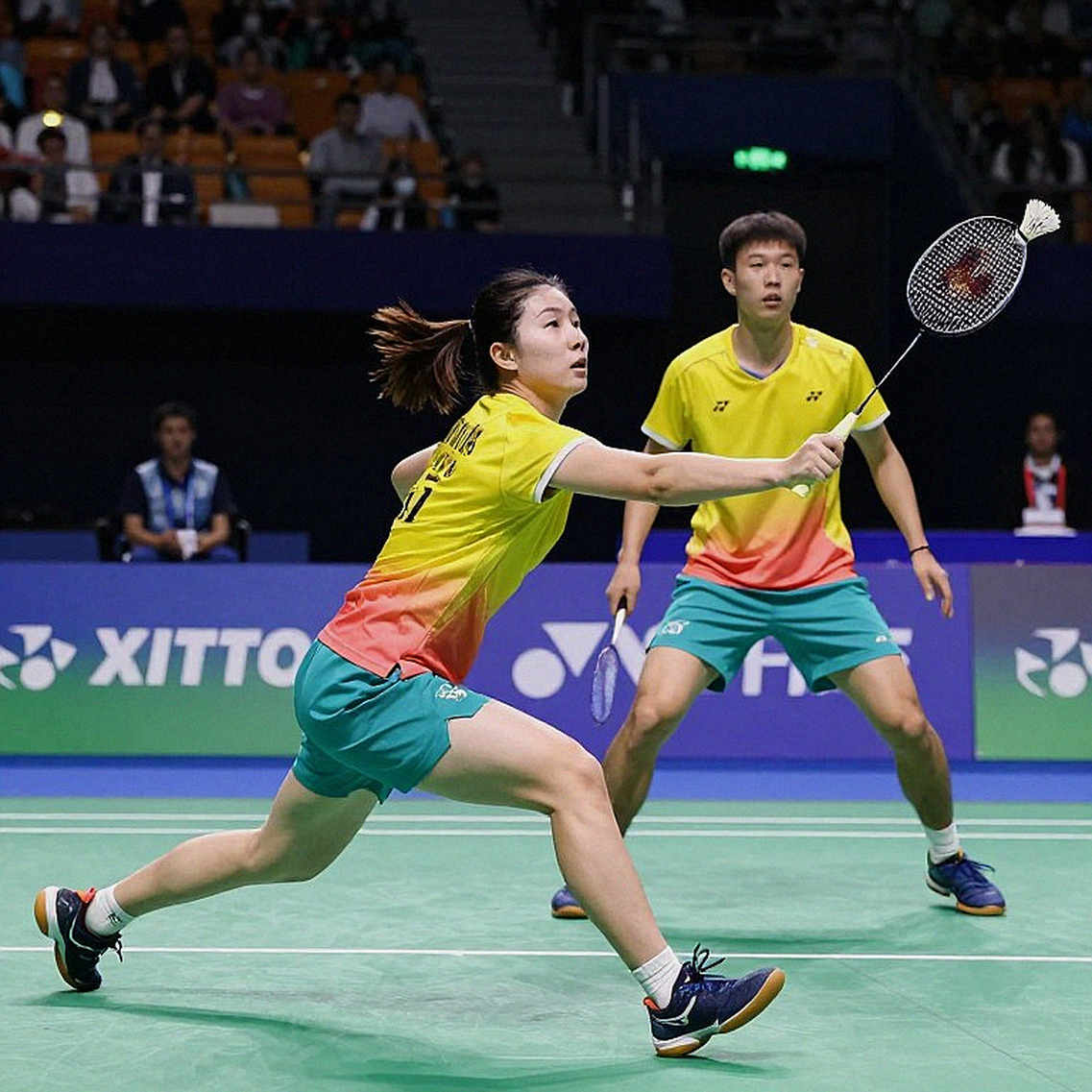
The report gives no tactical detail on the Thai pair, but the scoreline reveals something. Satwik-Chirag's win condition is well known: Rankireddy's back-court power and Shetty's net pressure, a front-back attacking formation. That model needs clean swings on the second and third shots. Without clean swings, the front player gets stuck, and the pair drops into side-by-side defence.
Against a compact pair that refuses to lift and instead keeps the rally short with flat exchanges, this model carries a familiar risk: the big hitter is dragged into mid-court retrievals and then the tempo is slowed against him. Second-tier Southeast Asian pairs can do precisely that, and often do it in team set-ups, because the cheapest way to beat a top seed over one match is to close the source of his power first.
The win was probably more scouting than talent. Coming back from 12-21 to win 21-19 and 21-14 against defending champions in round one usually requires a deliberate reset of serve-and-receive placement and of tempo control. That is a medium-confidence inference, because the report carries no tactical commentary. What is not an inference is the risk marker: if the pair's win condition is generating clean back-court swings, any compact counter-attacking pair will keep asking the same question, and answers not written into the game plan beforehand are almost impossible to write mid-match.
The format as amplifier
One bad game ends the campaign. Seeds exist, but error tolerance is thin, especially in the second and third rounds, where unseeded pairs arrive already match-fit. As fourth seeds, Satwik-Chirag carried no top-two protection, and once beaten they left the bracket entirely.
Single elimination does not create upsets; it raises the price of one. The word "shock" is easy to use, but the format is the primary amplifier of the shock. Without a five-to-seven match sequence, a single result cannot be turned into structural history.
India's doubles depth: the gap is not at the top
The two other doubles defeats on the same day were 21-14, 21-11 and 21-9, 21-5. Those two scorelines carry the most information of anything in the report. India's second and third-tier pairs, in the individual draw, did not play close matches. They played margins. And a margin is more than a numeric signal; it is a structural one.
India's problem is not at the summit; it is directly beneath the summit. The top pair remains world-class, as its seeding and defending-champion status attest. The trouble is that the shelf under them is so thin that one bad round places the weight of an entire national doubles programme on one pair's shoulders.
This is where my professional concern sits, and it is not in the report. I have spent years working on return-to-play, and the lesson is consistent: where a system has two or three viable pairs, the load on a star is distributed, and that distribution buys rest, load management, and tournament selection. Where there is no alternative, the star pair plays continuously, because representation at the table is their responsibility alone. That responsibility is not play. It is pressure, and pressure eventually invoices itself in the medical room.
A counter-signal in the same camp
The picture is not monochrome. On the same day, Unnati Hooda won 21-9, 21-10, with the margin running the other way. Dhruv Kapila and Tanisha Crasto won twice in mixed doubles, including 22-20, 24-22 against a Malaysian pair, holding their structure through points decided by one and two points. Next up for them: top seeds Feng Yan Zhe and Huang Dong Ping.
I am not calling these results a golden day. I am saying they balance the ledger. Under one sending structure, one athlete wins 21-9 while another wins 21-12 and finishes 14-21. That difference shows the problem is not the whole system; it sits in specific pairing structures, specific matchup preparations, and specific match-day decisions.
The mixed-doubles context makes the signal meaningful, since the discipline asks the male player to cover the back court and the woman to intercept at the net. Winning close points is not just skill; it is evidence of structure under pressure. For India it hints at a new medal pathway, though two matches in one day is a sample, not a trend.
The physical question, and the data void
External knowledge suggests Rankireddy carries a heavy load history; I am deliberately leaving that out, because it is not part of this report. What I am noting is the easier explanation that will circulate: the body broke down. That claim needs unit-level evidence.
Without data, an inference cannot sit in the decision chair. A seven-point decider makes it easy to write that the body collapsed, and it probably sells. But on what basis? No smash speed, no post-interval error rate, no load data, no travel log, no dated recovery markers. In my practice, that claim requires three independent scans, a written team medical statement, and a phased return-to-play table. Where those are missing, the honest move is to hold the verdict open. That is not weak analysis; it is discipline.
A limited, low-confidence observation is still available: power-dependent back-court styles generate a standing injury exposure that accumulates across dense calendars. I am not using it to explain this match. I am placing it once: long-term planning has to think about load monitoring and serve-receive variation together, because they are two faces of the same problem, one physical and one tactical.
Cycle turnover and the vulnerability window
Fajar-Fikri, Fukushima-Matsumoto: re-pairings are not just draw-sheet news. After an Olympic cycle they are close to routine. For a few months a window opens in which even established pairs lack full rhythm, because new divisions have not settled, and opponents know it.
Scouting-dependent pairs catch their biggest fish inside that vulnerability window. So the Thai win is not miraculous; it is a signal. And the signal also points at India: are they building their own new combinations, or will the top pair keep carrying the load?
Working from Sri Lanka, watching shuttlers across South Asia, I have seen how smaller badminton markets treat the Asian Games as both opportunity and risk. There are no ranking points, yet medal accounting feeds directly into funding and policy. This defeat therefore lands on two levels: momentum for the athletes, arithmetic for the institution.
What the headline will bury
The easy headline is this: defending champions toppled, streak broken. True, but incomplete, because two things get buried.
One is the nature of the accounting. With no ranking points at stake, the loss is momentum and confidence, not ranking. And momentum damage has a different evidentiary bar: one match proves nothing; three or four events begin to.
The other is weight distribution. The bigger story would have been the collapse of the second tier (21-9, 21-5 and 21-14, 21-11), but there is no star in that story, so there is no headline. Structurally it matters more, because it tells you where India needs to invest over the next two years.
The most sensitive part, though, is language. Framing a pair as having to "prove themselves" immediately after a bad result is corrosive on two fronts. It presses on the players' confidence, and it pressures tactical rebuilding, because under pressure a model gets smashed rather than modified. A smashed model takes time to reassemble, and time is not a resource a season gives back twice. Doubt added at the moment a pair leaves its peak does not repair anything; it breaks the pairing.
What I will watch, and where the trigger sits
Over the next two or three events I will watch three things in Satwik-Chirag: whether the second-game initiative returns in the first three shots after the interval; whether serve-receive patterns show deliberate variation; and whether the burden of sole national representation eases.
For Dhruv and Tanisha the question is different. How much structure they hold against the top seeds will reveal their true position. For India's doubles programme the ledger is larger: whether the next 12 to 24 months bring investment in second and third pairs. That is the real result.
As long as the rolling six-match tape shows only isolated swings, I will keep writing 21-12, 19-21, 14-21 as an upset, and I will not write an injury claim at all, because there is no scan. But if early exits become a sequence, the file that opens first will not be a performance file. It will be a depth file. India lost a match at this tournament. The question is whether they lost a match, or lost a structure.